
Ventricular Arrhythmias
Premature Ventricular Contractions (PVCs) are seen commonly and increase in prevalence with age. In the absence of underlying heart disease, they do not adversely affect prognosis, and should not be treated unless the patient has intolerable symptoms. In the setting of underlying heart disease, particularly when the ejection fraction is less than forty percent, the presence of complex ventricular ectopy, particularly non-sustained ventricular tachycardia, is associated with an increased risk of sudden cardiac death due to sustained ventricular tachycardia or fibrillation. However, the patients at highest risk are those with a left ventricular ejection fraction of 35% or below. Patients with only moderate left ventricular dysfunction (ejection fraction above 35%) may benefit from electrophysiologic testing, though several studies have suggested that EP testing may not be as predictive as was once thought. Patients with near normal ejection fractions generally have a favorable prognosis (in the absence of symptoms such as syncope or presyncope) and treatment of ventricular ectopy should be limited to beta blocker therapy. Empiric antiarrhythmic therapy for ventricular arrhythmias in patients with underlying heart disease has been associated with increased mortality, presumedly due to pro-arrhythmic effects of these potent drugs. In patients with totally normal hearts, use of Class IC agents may be very effective to suppress the ectopy and relieve intolerable symptoms. Amiodarone does not appear to be pro-arrhythmic, and can be used to reduce ventricular arrhythmias in patients with significant underlying heart disease. However, long-term use of amiodarone runs a significant risk of organ toxicity and those risks need to be considered when selecting a treatment for patients with symptomatic ventricular arrhythmias.
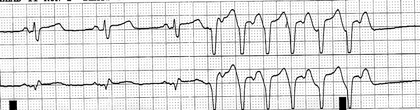
Ventricular tachycardia (VT) is defined as a ventricular tachyarrhythmia with a rate above one hundred beats per minute. Sustained ventricular tachycardia is defined as lasting over thirty seconds or being hemodynamically unstable such that intervention before thirty seconds is necessary. Non-sustained VT refers to VT lasting from 3 beats up to 30 seconds. Ventricular tachycardia may be monomorphic (all QRS complexes look alike) or polymorphic (QRS complex morphology varies). One specific type of polymorphic ventricular tachycardia is known as Torsades de Pointes, which most commonly occurs in the setting of the acquired (drug-induced) or congenital long QT syndrome. Sustained monomorphic ventricular tachycardia usually occurs in the setting of underlying heart disease such as an old myocardial infarction or in cardiomyopathy, but rare cases of “idiopathic” ventricular tachycardia may arise in patients with normal hearts. Sustained ventricular tachycardia should be considered a potentially life-threatening arrhythmia, usually representing reentry within the ventricular myocardium. The acute treatment of unstable (pulseless) sustained ventricular tachycardia is immediate electrical cardioversion. If the patient is relatively stable, antiarrhythmic therapy using intravenous lidocaine or amiodarone can be used to terminate the VT. Acute ischemia is a rare cause of sustained monomorphic ventricular tachycardia. Although revascularization should be performed if deemed appropriate, revascularization does not eliminate the myocardial substrate that gives rise to monomorphic VT. Therefore, treatment is indicated in all patients with sustained monomorphic ventricular tachycardia that does not occur within the first forty-eight hours of an acute myocardial infarction. Polymorphic ventricular tachycardia (in the absence of QT prolongation) should be considered secondary to ischemia or metabolic disturbances until proven otherwise.
Distinguishing ventricular tachycardia from other wide-QRS complex arrhythmias such as supraventricular tachycardia with aberrant conduction is usually possible, based on the twelve lead morphology, the presence of AV dissociation, and most importantly, the clinical history. In patients over the age of forty, particularly those with a history of cardiac disease, any wide QRS tachycardia should be assumed to be ventricular in origin and should be treated as such until proven otherwise. Electrophysiologic testing may be performed if the mechanism of the tachycardia is in question. Currently, the gold standard in treatment of sustained ventricular arrhythmias is the implantable cardioverter-defibrillator (ICD). These devices are very effective to terminate sustained ventricular arrhythmias and the risk of implantation is relatively low (the complication rate is approximately 2-4%). In many large randomized studies, ICD therapy has been found to be superior to medical therapy in high-risk patients (ejection fractions less than 35%), even when used as “primary prevention” in patients without a history of spontaneous ventricular arrhythmias. These studies demonstrated improved survival in patients with LV dysfunction who received an ICD.