
Sudden Cardiac Death
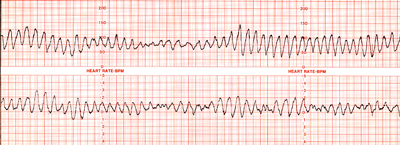
Sudden cardiac death (SCD) is defined as death that occurs less than one hour after onset of symptoms. Approximately 350,000 Americans die each year of SCD. In most communities, the chance of surviving SCD is less than 5%, though the outcomes are significantly better if the SCD occurs in a hospital because of immediate resuscitation. The widespread use of the AED (Automatic External Defibrillator) has improved the survival rate of a SCD event that occurs in public places like schools and office buildings. SCD is only rarely due to acute myocardial infarction. Bradycardia is also a rare cause of sudden death but profound bradycardia may lead to ischemia-mediated ventricular arrhythmias. Sudden cardiac death almost always occurs in the setting of underlying heart disease. It is most often due to sustained ventricular tachycardia that degenerates into ventricular fibrillation. Sustained monomorphic ventricular tachycardia is usually due to reentry either from an old myocardial scar or a cardiomyopathy. In certain circumstances, modification of the myocardial substrate with catheter ablation can be accomplished. Catheter ablation of ventricular tachycardia is associated with a relatively low complication rate, and success rates may be as high as 80%. Antiarrhythmic drugs are rarely effective, and side effects (including proarrhythmia) occur commonly. In general, survivors of SCD should receive an implantable cardioverter-defibrillator (ICD). ICDs do not prevent arrhythmia recurrence but are capable of automatically detecting the presence of a sustained ventricular arrhythmia and automatically terminating it with either a rapid burst of ventricular pacing (to terminate reentry) or with a low or high energy electrical shock delivered directly to the heart muscle. All ICDs are capable of bradycardia pacing as well, and some models are also capable of cardiac resynchronization therapy (see below). The ICD leads are inserted transvenously like a pacemaker and the box or "pulse generator" is implanted subcutaneously in the upper chest (pectoral) region. Complications of implantation are quite low but include infection, bleeding, lead dislodgement, pneumothorax, cardiac puncture and tamponade. ICDs are extremely reliable and the battery can last up to 10 years or so. At that point, the pulse generator can be easily replaced.
Cardiac Resynchronization Therapy (CRT) is the latest treatment for symptoms of congestive heart failure in patients with left ventricular dysfunction and a wide QRS complex. Widening of the QRS indicates a loss of normal Purkinje system function, leading to abnormally delayed contraction of parts of the myocardium. In the case of a left bundle branch block, the lateral wall of the left ventricle contracts later than the LV septum, leading to disturbances in LV filling, a reduction of ejection fraction, and functional disturbances in papillary muscle function leading to mitral regurgitation. CRT involves pacing of both ventricles simultaneously with the use of a standard right ventricular pacing lead in combination with a pacing lead placed in one of the tributaries of the coronary sinus, allowing effective stimulation of the lateral wall of the left ventricle. By resynchronizing the left and right ventricular contraction, an improvement in functional class can occur in up to 75% of patients. Not all patients benefit, however, and the clinical improvement enjoyed by many patients may be the result of a significant placebo effect seen with device implant. Nevertheless, many patients have a significant reduction in their heart failure symptoms, and CRT has also been associated with improved survival in patients with severe congestive heart failure.